
 輕鬆聽大師
俞國定導讀



用系統打造理想生活
想讓改變持久發生,不能只靠一時的意志力。透過微調日常環境養成原子習慣、放下完美主義啟動微幅行動,並在刻意設限中聚焦關鍵瓶頸,就能讓理想生活自然運作。
| 今天讓明天更好過 |
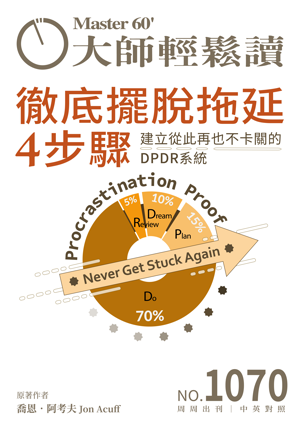
概念:拖延有時不是因為缺乏自律,而是遲遲不允許自己在條件不完美時開始。許多人以為必須先有完美計畫或充沛動力才能行動,反而因為步驟太繁瑣而寸步難行。透過「夢想、計畫、行動、檢討(DPDR)」循環系統,把計畫簡化為「今天做點小事,讓明天更好過」,並允許自己先採取不完美的行動,就能用實際動能取代空轉等待。
案例:中小企業主布蘭妮.尼爾森每當面對工作提不起勁、遲遲無法專注時,不會強逼自己苦撐一整天,而是拿出一根棒棒糖,跟自己約定:「只要在吃完這根棒棒糖的時間裡全神貫注就好,吃完想繼續或停下來都可以。」結果多數時候,等棒棒糖吃完,大腦早已跨過最沉重的啟動門檻、自然進入順暢的工作節奏,根本不想停下來。這證明只要把開始變簡單,動能就會接手後續的推進。
練習:透過3個行動建立不卡關的推進系統:
1
從最耗時間的應用程式找回1小時──打開手機的「螢幕使用時間」設定,找出上周最耗時間的應用程式(例如上周滑了10小時Instagram,這周就刻意少滑1小時、減為9小時),在接下來3天騰出這1小時,投入能讓這周變精采的要事。
2 像工程師計畫,像藝術家生活──事前用簡單結構明確定義「下一步是什麼、何時做」並排入行事曆;執行時則在允許試錯的工作中,先接受適度不完美(例如在寫作、健身與創業練習中建議的「接受5%不完美以換取95%完成度」),完成可用版本再逐步修正。
3 把數據與情緒分開來檢討──定期回顧「發生什麼事、哪些有效、哪些無效」,不因進度落後而編造自責故事,只根據客觀事實微調下一步。
| 善用限制,聚焦關鍵瓶頸 |
概念:人們常誤以為擁有無限的時間、資源與自由才能創造最佳表現,但毫無邊界的自由反而容易導致功能過載與精力分散。真正的突破往往來自「深思熟慮,迅速行動」——在行動前先設定明確界線、決定「不做什麼」,並運用「限制理論」找出系統中拖慢全局的單一瓶頸,將資源集中於關鍵點,讓限制成為提升專注與創意的催化劑。
案例:矽谷傳奇公司General Magic曾投入大量資源開發超前市場的行動裝置,但在欠缺明確邊界下不斷疊加新功能,最終因產品複雜、製造成本高昂與市場條件未臻成熟等問題而未能取得商業成功。曾任職該公司的東尼.費德爾記取教訓,後來在蘋果領軍開發iPod時,於2001年3月先用保麗龍模型獲得賈伯斯核准,並設下「2001年耶誕節前出貨」的期限,迫使團隊善用現有技術,在同年11月(約8個月內)備妥上市;日後他創辦智慧恆溫器公司Nest時,更先做出貨架包裝盒原型再逆向開發,聚焦顧客最需要的功能。
練習:透過3個步驟把限制轉化為系統優勢:
1
啟動前先決定「不做什麼」──在投入執行前先停下腳步定義成功標準,主動剔除偏離核心的附加目標,用減法取代無止境的加法。
2 集中火力解決單一瓶頸──物理學家高德拉特曾協助一家24人的雞舍製造廠改善排程,發現無論其他組裝步驟多快,總產量始終受制於最慢的那個步驟;他僅將其他環節的1名人力調去支援該瓶頸,就在不增加總人力的情況下讓產量翻了3倍。檢視工作時,也應找出最拖慢全局的單一卡點優先解決,而非分散精力同時改善所有地方。
3 用清單與時限保護專注力──在工作環境中建立檢查清單、回饋機制與明確截止日,並減少多工切換,讓環境自然支持高效表現。
Concept: Most people chase once-in-a-lifetime transformations, overlooking that extraordinary achievements are the compound product of daily habits. When you struggle to change habits, the problem isn't you—it's your system. Goals are for winning the game, while systems keep you playing; by aligning your environment with the four stages of Cue, Craving, Response, and Reward to make good habits obvious, easy, and immediately satisfying, positive behavior happens naturally.
Case Study: In 2003, Dave Brailsford became performance director of British Cycling and applied "the aggregation of marginal gains," improving every aspect of cycling by 1%. They redesigned seats, rubbed alcohol on tires for grip, tested aerodynamic fabrics, painted truck interiors white to spot dust, and had a surgeon teach riders handwashing to prevent colds. Hundreds of tiny upgrades compounded: Great Britain won 60% of Olympic cycling golds in Beijing and set seven world records in London, while British riders claimed five Tour de France titles in six years.
Practice: Build a habit system with three simple rules:
1
Use habit stacking and environmental cues – Link a new habit to an established routine ("After X, I will do Y"), place tools for good habits in plain sight, and hide cues for bad ones.
2 Apply the "2-Minute Rule" to reduce friction – Scale any new habit down to a two-minute version (like reading one page or putting on running shoes) so you standardize showing up before optimizing.
3 Track streaks and "never miss twice" – Mark an X on a calendar each time you act for immediate satisfaction; if life interrupts your streak once, simply make sure you never miss twice in a row.
| Make Tomorrow Easy Today |
Concept: Procrastination is sometimes not a lack of discipline, but a reluctance to give yourself permission to begin when conditions are imperfect. People often stall because they overcomplicate plans or wait to feel "ready." By running the repeatable "Dream, Plan, Do, Review (DPDR)" loop, simplifying planning to "make tomorrow easy today," and giving yourself permission to take imperfect action, you replace delay with momentum.
Case Study: Whenever small business owner Brittany Nelson struggled to focus on a task, instead of forcing herself through a grueling marathon session, she grabbed a Blow Pop lollipop and made a deal with herself: she only had to focus for the time it took to finish eating it, after which she could stop or continue. Most of the time, by the time the lollipop was gone, her brain had crossed the heavy starting threshold and found a productive groove—proving that once you make starting smaller than avoiding, momentum handles the rest.
Practice: Keep moving forward with three practical actions:
1
Reclaim one hour from your most time-hungry app – Open your phone's screen-time settings, find the app that consumed the most time last week (for example, if you spent 10 hours on Instagram, cut it back to 9 hours), and use that reclaimed hour over the next three days for a meaningful goal.
2 Plan like an engineer, live like an artist – Define a clear next step on your calendar, then in work that allows trial and error, accept modest imperfection first (for example, accepting 5% imperfection for 95% completion in writing, fitness, or business) to finish a usable version and refine iteratively.
3 Separate data from drama during reviews – Regularly review what happened, what worked, and what didn't without inventing self-critical stories, using objective facts to adjust your next step.
| Use Constraints to Target Bottlenecks |
Concept: We often assume unlimited time, resources, and freedom produce the best results, yet boundless freedom frequently leads to feature creep and scattered energy. Real breakthroughs come from "Think Slow, Act Fast"—setting clear boundaries and deciding what not to do before acting, then applying the "Theory of Constraints" to find and relieve the single bottleneck holding back the entire system.
Case Study: Silicon Valley pioneer General Magic invested heavily to develop an ahead-of-its-time mobile device, but without clear boundaries it kept adding features—ultimately falling short of commercial success due to product complexity, high production costs, and market conditions. Former General Magic engineer Tony Fadell learned that lesson: when leading Apple's iPod team, he got Steve Jobs's approval on a styrofoam model in March 2001 and set a Christmas 2001 shipping deadline, pushing the team to use existing technology resourcefully and get the first iPod ready to ship by November 2001 (in roughly eight months). Later at Nest, he designed the retail box prototype first and worked backward to focus on essential customer features.
Practice: Turn constraints into system advantages with three steps:
1
Decide what not to do before starting – Define what success looks like up front and deliberately subtract side objectives that distract from your central purpose.
2 Focus on the single biggest bottleneck – When physicist Eli Goldratt helped a 24-worker chicken-coop factory improve its schedule, he found that no matter how fast most assembly steps ran, total output was always limited by the single slowest step; simply moving one worker from another step to support that bottleneck tripled output without adding headcount. Likewise, find and relieve the single constraint slowing your workflow rather than spreading effort everywhere.
3 Protect focus with checklists and deadlines – Use simple checklists, feedback loops, and clear deadlines while cutting out multitasking so your environment quietly supports your best work.
推薦書單

NO.722 原子習慣
Atomic Habits: An Easy & Proven Way to Build Good Habits & Break Bad Ones
by 詹姆斯.克萊爾(James Clear)
中文版:原子習慣(方智,2019)
NO.1070 徹底擺脫拖延4步驟
Procrastination Proof: Never Get Stuck Again
by 喬恩.阿考夫(Jon Acuff)

NO.1084 盒內思考法
Inside the Box: How Constraints Make Us Better
by 大衛.艾波斯坦(David Epstein)


